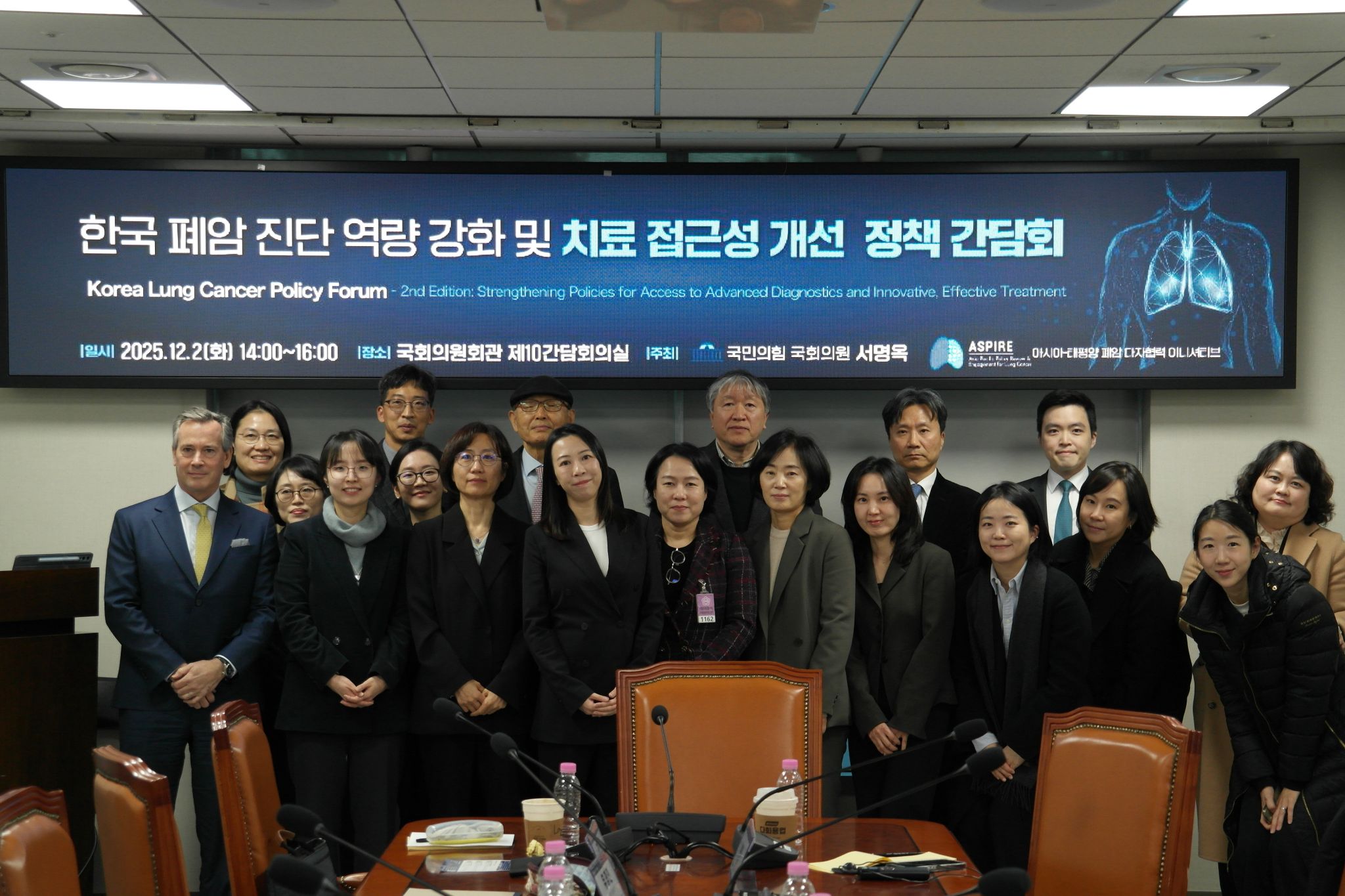
On 2nd December, ASPIRE convened the 2nd Korea Lung Cancer Policy Forum, building on momentum from our first roundtable. Co-hosted with National Assembly member Suh Myung-ok, the forum brought together policymakers, clinicians, researchers and patientadvocates to strengthen policies that expand access to advanced diagnostics and innovative, effective lung cancer treatment in Korea.
The roundtable focused on:
🔹 Expanding access to precision diagnostics ⚠️ Challenge: NGS reimbursement is tied to specific lung cancer subtypes, creating access barriers for patients outside these criteria ➡️ Next step: Broaden eligibility, so all clinically appropriate patients can access genomic testing, and support multiplex PCR while NGS results are pending
🔹 Scaling digital diagnostics ⚠️ Challenge: Hospitals, especially outside Seoul, face barriers to adopting digital pathology (high costs, limited reimbursement), driving variation in timely diagnosis ➡️ Next step: Introduce reimbursement codes and targeted incentives for digital pathology and AI to support a national diagnostic network
🔹 Ensuring timely access to innovative treatments ⚠️ Challenge: Reimbursement timelines may not keep pace with new therapies, creating access gaps ➡️ Next step: Establish a fast-track reimbursement pathway and use Korean real-world data to support timely coverage updates
🔹 Strengthening data infrastructure for real-world evaluation ⚠️ Challenge: Limited integration across data sources constrains domestic real-world evidence generation ➡️ Next step: Develop a unified national platform linking hospital, claims, and genomic data, with AI tools to support analysis and reduce bottlenecks
🔹 Closing equity gaps ⚠️ Challenge: Regional and income-related differences affect timely diagnosis and early detection ➡️ Next step: Strengthen regional hospital networks and improve screening outreach, clearly communicating low-dose CT as the guideline-recommended screening method
Together, insights from both roundtables span the full lung cancer care continuum and will help inform Korea’s upcoming 5th National Cancer Control Plan. ASPIRE will consolidate these insights into a policy brief to turn this multi-stakeholder vision into concrete action.
Thank you to all presenters, panellists and participants for their insights and leadership: Prof. Choi Yoon-la (Samsung Medical Centre), Prof. Kang Jin-hyoung (KALC), Yoo Jeong-min (MoHW), Seo Young-hoon (NHIS), Kim Sang-ji (HIRA), Prof. Jang Seung-hoon (Hallym University Sacred Heart Hospital), Prof. Kim Yeon-wook (Seoul National University Hospital) and Cho Jeong-il (Korea Lung Cancer Patients Association).

We are a collaborative multilateral effort focused on improving lung cancer outcomes in the Asia-Pacific region through policy reforms.
